Navigating Your Retirement Tax Strategy: Sherri’s Journey to Tax Diversification

When planning for retirement, there’s often a lot of focus on growing your nest egg through diversified investments, but what about diversifying your taxes? This is about strategic and long-term tax planning that could lower your tax bill and maximize your retirement income.  

–––––––––––––––––––––––––––––––––––––––––––––––––––––––––––––––––––––––––––––––––––––––––––––

We explore the concept of tax diversification, illustrated by the hypothetical scenario of a woman named Sherri who has planned for retirement income and identified that she needs to take $100,000 from her retirement investments to fund her desired lifestyle for one year. Through three scenarios, we see how different distributions from various tax buckets can significantly impact her net spending power. 

Scenario One: Traditional IRA

In this scenario, Sherri draws her entire $100,000 retirement income from a traditional IRA. Since all withdrawals from this account are subject to ordinary income tax, Sherri’s spendable income is reduced to $87,000 after taxes. This method is common due to familiarity with traditional IRAs and 401(k) plans, but as the planners explain, it’s not the most efficient strategy. 

Scenario Two: Introducing Roth Conversions

Here’s where Sherri starts getting creative. Now, she distributes her income between a pre-tax IRA and a Roth IRA – a move made possible by prior Roth conversions. By taking $50,000 from her pre-tax IRA and another $50,000 tax-free from her Roth IRA, Sherri increases her net income to $96,000. This scenario showcases how Roth IRAs can enhance retirement income through tax-free qualified distributions. 

Scenario Three: Tax Diversification

In the third scenario, Sherri maximizes her tax diversification by incorporating a third bucket: non-qualified accounts, which might include brokerage accounts or bank savings. 
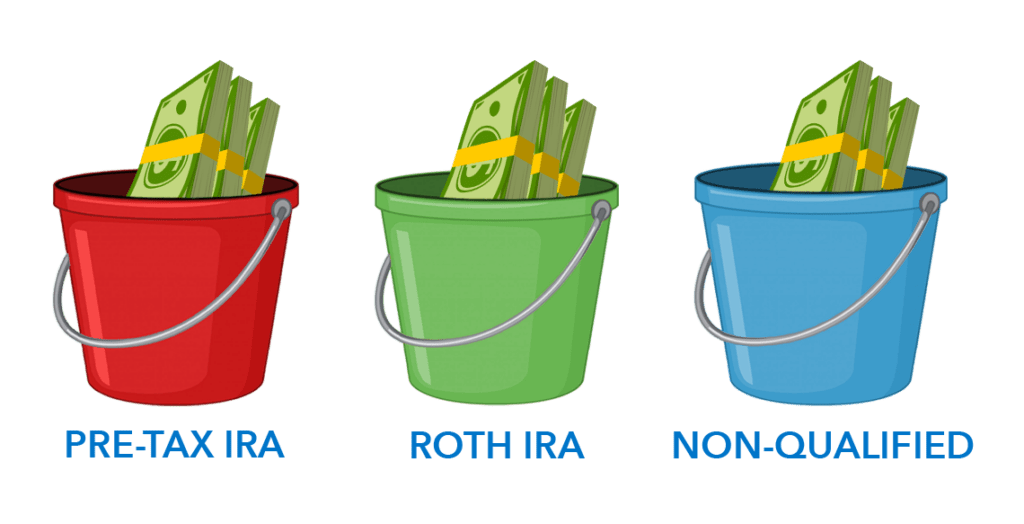
She strategically withdraws $30,000 from her pre-tax IRA, $40,000 from her Roth IRA, and $30,000 from her non-qualified accounts. 

This approach leaves her with $98,000 of net spendable income, underscoring the power of strategic planning. 

Each scenario underscores the critical role of planning ahead for tax efficiency. Roth conversions, which allow for transferring funds from a traditional IRA to a Roth IRA while paying taxes in the year you do the conversion, can be a game-changer. This strategy allows for tax-free growth and qualified distributions later, making it particularly attractive for those aiming for financial flexibility in retirement. 

Retirement Planners Loren Merkle and Chawn Honkomp also stress the importance of a long-term tax strategy, distinct from annual tax filings. Instead of focusing solely on minimizing taxes each year, they advise considering how to minimize taxes over the course of your entire retirement. This involves projecting future tax scenarios and potential changes to tax laws that might affect retirement funds. 

Click here to watch the full episode “Three Ways to Lower Taxes in Retirement” on YouTube!

FOLLOW US ON SOCIAL

Visual-Insights-Newsletter-Ad_v2

Sign-up for our Visual Insights Newsletter for the latest retirement information and strategies – straight to your inbox.

  • This field is for validation purposes and should be left unchanged.

Discover more strategies you could be missing out on
Man standing next to text that says, "Laid off in your 50s?"

Facing a Buyout or Layoff? Key Retirement Questions to Answer Before You Decide

If you’re offered a buyout or find yourself retiring earlier than planned, several important financial questions come into play. From health care coverage before Medicare to tax implications and 401(k) strategies, here’s what to consider as you evaluate whether early retirement is truly within reach.  When Retirement Happens Sooner Than Expected For many workers in their 50s and early 60s, retirement doesn’t always unfold…

Read More...
Man smiling next to text that reads, "$2 Million All Pre-Tax 3 Strategies."

$2 Million Saved ALL Pre-Tax: 3 Strategies to Reduce Your Tax Bill

A large IRA can be a powerful retirement asset—but it also comes with tax implications and planning decisions. This blog explores three strategies retirement planners often consider for large IRAs: reducing taxes strategically, turning savings into reliable retirement income, and creating a lasting legacy. Understanding the Basics of an IRA  An IRA or Individual Retirement Account is one of the most…

Read More...
Two women standing in between the phrase, "The Loneliness Factor".

The Hidden Crisis Facing Pre-Retirees

Loneliness is rising among adults over 45, and it can have a powerful impact on health, happiness, and fulfillment in retirement. Here’s what recent research reveals—and how thoughtful retirement planning could help protect connection and purpose in the years ahead. Loneliness Is Rising—And Often Unspoken A recent AARP study found that 40% of adults age 45+ meet the criteria for loneliness. That’s up from 35%…

Read More...

Do Roth Conversions Still Make Sense in 2026?

A Roth conversion can reshape your retirement tax strategy. This blog covers how it works, when it makes sense, and what to consider before making this decision. What Is a Roth Conversion? The basic idea behind a Roth conversion is simple: pay taxes now in exchange for tax-free growth later.  As Retirement Planner Loren Merkle explained, “What a Roth…

Read More...
Man standing next to text that says, "Hint: It's Not Your 401(k)

What is a Retirement Plan? Hint: It’s Not Your 401(k)

Many people assume their retirement savings tell them everything they need to know about the future. This article explores why a 401(k) is only one piece of the puzzle and what a true written retirement plan includes, from income and taxes to health care and legacy planning.  The 401(k) Balance For many people approaching retirement,…

Read More...
Man standing next to a chart and text that reads, "Stress Testing".

Retirement Road Test: $1 Million Portfolio

A common saying is you need a million dollars for retirement, but what does that actually mean for you? In this blog, you’ll meet Tom and Sandi. They have $1 million saved for retirement at age 65, and in the first iteration of their retirement road test, that money was projected to run out by age 79. Rather than…

Read More...

Ready to take your retirement to the next level?

Let's chat! Schedule a RetireReady Call to talk with a retirement planner about your retirement vision.

Ready to take your retirement to the next level?

Let's chat! Schedule a RetireReady Call to talk with a retirement planner about your retirement vision.

Call Now Button